








Check out my first LIVE CASE STUDY and watch me build a 300,000+ page site! I show everything – domain, Google analytics, SEO strategy...

The Man Who Sold the Web Blog | Learn the ins and outs of autoscale, autopilot sites that add value


21K in 21 Days (my latest free eBook).

8 May

Last week, I took the results from the first 21 days of my live SEO case study, analyzed it, and compiled everything (data + analysis) into a book, 21K in 21 Days.  This is another free guide, which you can download here.

Here is some of what you will find in the book:

  • Day-by-day update log — so you can see indexing growth rates and plateaus
  • Detailed analytics — screenshots taken from Google Analytics
  • Key insights
  • Site architecture/design

  • SEO strategy

I think many people may find the “Key insights” section the most interesting part of the book, because I highlight insights that counter conventional “wisdom” about Internet Marketing.  So, I’ve reproduced most of that section below here (for those too lazy to download the book). […]
Learn to autoscale with the best source of information, Wikipedia.

7 May

Wikipedia is such a great source of information.  Though originally controversial as a source of legitimate information, it has becoming increasingly accepted as a reliable source.  In fact, in my day job of business consulting for companies (including Fortune 50 organizations), Wikipedia is one of the first places I check when conducting research.

However, if you have a website, and would like to automate the process of pulling data from Wikipedia, it’s not a simple task.  You will need a very sophisticated scraper.  Wouldn’t it be convenient if you could just query Wikipedia like a database?

Well, it seems like you actually can… with the help of DBpedia. […]

Black Hat SEO. Everyone does it, so should you?

29 Apr

Black hat SEO is a topic that has been getting a lot of media attention, as of late.  The term black hat SEO refers to manipulating Search Engine results using “unethical” means. Here’s more info on the top from Wikipedia.

A couple days ago, this article was published: Sequoia Fails to Spot Milanoo’s Black Hat Tactics Before Investing.  It details how a fashion start-up, Milanoo, backed by the most well known Venture Capital firm, Sequoia, engaged black hat tactics to rank itself for 4 keywords:  “cheap dresses” (rank 2), “evening gown” (rank 1), “cheap wedding dresses” (rank 1), and “summer dresses” (rank 2).    In terms of Google AdWords spend, these 4 terms and spots are worth $200K/month.

It’s quite an interesting read and makes you question how you can successfully compete with someone engaging in black hat.  (In case you’re wondering, I consider the SEO Matrix methodology white hat.)

So, are only the more daring, budding start-up sites engaging in black hat techniques?  Certainly not!  The New York Times published a great article just two months prior on the wide use of black hat by well known Fortune 500 companies. […]

The SEO Matrix, deconstructed.

27 Apr

The SEO Matrix is a SEO strategy that I created and have been tweaking over the past 6 months or so.  I’ve found it very powerful, since it touches upon all 6 levers to successful SEO strategy.

In fact, in my recent case study, Case of the 300K Site, the only SEO work I did is create 4 SEO Matrices.  In this article, I will explain how the SEO Matrix is constructed and why it’s so effective.

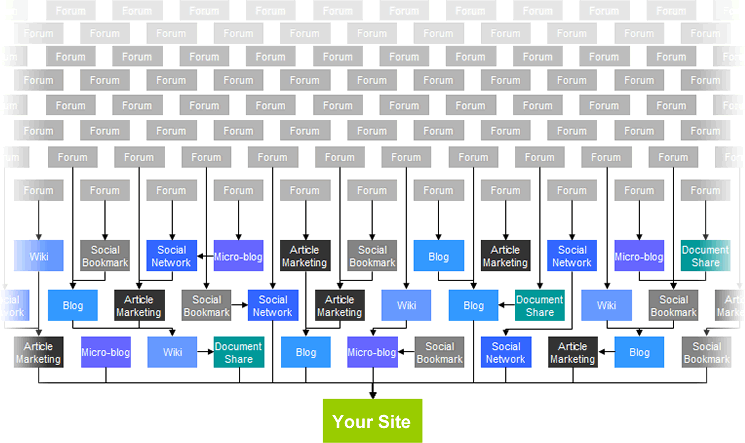
Creating a SEO strategy is essentially designing a backlink infrastructure pointing to your site.  In designing this infrastructure, there are 2 key buckets of questions to address:

  • What are your backlinks? Do you want social bookmarks?  Forum links?  Blog posts?  Article marketing?  Similarly, what’s the proper mix?
  • How do your backlinks interconnect? Which web properties link to your site?  Which link to each other?  How many tiers do you have?

The SEO Matrix is a 4 tiered design, with links (I call these vertices) spanning 8 different types of site categories and that randomly interconnect.  Here is a diagram to help you visualize the SEO Matrix.

[…]

Here’s some inspiration from Steve Jobs.

15 Apr

Sometimes, all we need is a little inspiration to get things going.  One of the most motivating speeches I’ve come across is by one of the most successful and well known entrepreneurs, Steve Jobs.

Steve Jobs, as  their class commencement speaker, delivered this speech to the students of Stanford, class of 2005.  Here is the full transcript. […]

Use publicly available datasets to create a value-added megasite.

14 Apr

A few days ago, I launched a live case study where I created a 300,000 page site. One curious reader emailed me and referred to it as a “megasite.”  She saw the value in creating these massive sites and was very interested in creating her own megasite.  So, let’s discuss this concept further.

In my recent case study, I was able to create 300,000 page site (upon launch) by leveraging an API.  In this article, we will explore another method of creating a value-added megasite.  We will leverage publicly available datasets, instead.

First thing’s first.  What is a dataset? With some help from Wikipedia, a dataset is defined as a collection of data, usually presented in a table. Each column represents a particular attribute.  Each row corresponds to a given entry of the dataset.   For instance, if we have dataset on cars, the columns can be “model,” “make,” “color,” “year,” and “license.”  Then, an example of a row entry could take on the values “Accord,” “Honda,” “White,” “2009,” “TMWSW23.” […]

Live Case Study: The case of 300,000 pages and counting.

11 Apr

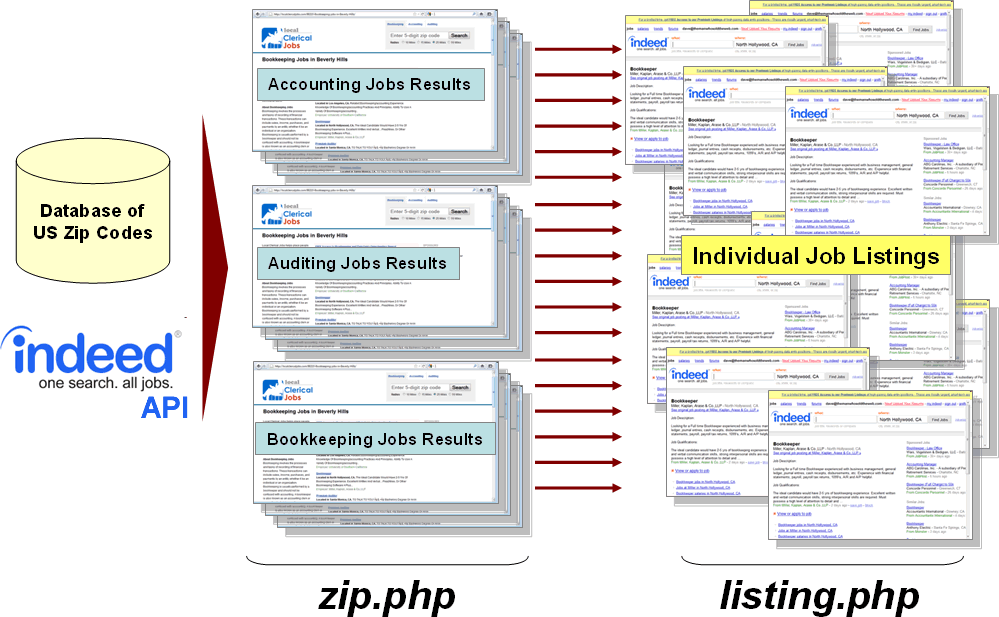
This is my first live case study.  In this case study, I will build and grow an autoscale, autopilot, value-add site from scratch.  The purpose of this case study is to demonstrate techniques in real time.  With the exception of coding the initial site (these activities are tabulated under day 0), everything is done in real time, including domain registration.

The subject of this case study will be a a niche jobs search site, built off the Indeed API.  Indeed.com is an established jobs search engine of US-based job opportunities.  They have a publishers program with an API that allows our site to pull the job results.  For job seekers that click through to Indeed, we will also get paid as a publisher.  A nice added bonus, eh?

Our niche job search site will focus on clerical jobs.  Within clerical jobs, we have 3 sections: 1 for accounting jobs, 1 for bookkeeping jobs, and 1 for auditing jobs.

Now, how does the autoscale work?

First, upon launch, the site will have 300,000 pages.  Note, this does not mean all 300K pages will be indexed by Google.  It only means a Googlebot will find 300K unique pages across our site.  Here’s how I came up with that estimate. […]

HousingMaps, an autopilot, value-add site with the potential to autoscale.

7 Apr

A couple days ago, I posted an article about autoscaling via an API.  (I suggest you read that article first, as it provides some context for this discussion.)  In this article, we’ll examine a site that adds tremendous value, is on complete autopilot, and gets all its content from other sites.   The unfortunate thing is… it doesn’t autoscale.

The site is HousingMaps.  Have a look.

[…]

Check out my interview with RA Project.

6 Apr

Recently, I had the privilege of being interviewed by Bes Zain, founder of the Reader Appreciation Project.  RA Project is one of the first and, likewise, longest running blogs on the Internet!

In the interview, I discuss one of my biggest projects, NuTang, and my latest project, this one–The Man Who Sold the Web.  I answered questions around automation, niche selection, past mistakes, among others.  You can read the full interview here:

http://raproject.com/blog/starting-niche-autopilot-sites-nutang-creator-david-tang-interview

If you have any questions after reading the interview, please reply directly to that article.  I will be responding to questions there.

Thanks.

dave

Here’s an easy way to autoscale. Use an API.

5 Apr

So, you want to autoscale your site.  Now what?

A great and easy way to autoscale is to leverage another site’s API. What’s an API, you ask?  An API, or application program interface, is, as defined by Wikipedia, a particular set of rules and specifications that a software program can follow to access and make use of the services and resources provided by another particular software program that implements that API.  Okay, now let’s translate that into English.  An API is a tool that big sites (e.g. Google, Wikipedia, eBay, Amazon) create to allow other sites (i.e. think your site) to easily access their data.

Here are some examples.  Amazon and eBay affiliate sites all use APIs provided by Amazon and eBay.  That’s how they are able to extract all the product info they need for their own spin-off sites.  This is also how sites integrate Google Maps–by leveraging the Google Maps API.

Now, how does this help you autoscale?

An API is the doorway between your site and your site’s content.  This means you essentially don’t need to create any data yourself, because all the data you need is already created for you.  You just need to go through the API (i.e. the doorway) to get the data being requested by your site’s visitor.  […]

| TheManWhoSoldtheWeb.com

I'll send you an email when there's exclusive or important news. Subscribe below.

© Copyright 2011-2026.   TheManWhoSoldtheWeb.com