










Introducing the HiBot AI Visibility Audit Service: Discover what AI is (and isn’t) telling customers about you
29 Jul

If you sell anything online, most of your customer research now happens somewhere you can’t see.
Ten years ago, a shopper opened Google, typed a query, and clicked around. You could watch that behavior in Analytics. You could bid on the keyword. You could rank a page and, if you did the work, you’d get the click.
That path is closing fast. ChatGPT now reaches more than 800 million people a week, roughly 1 in 10 adults on the planet. In an early-2025 survey, 58% of consumers said they had already replaced traditional search engines with generative AI for product and service recommendations. Gartner expects traditional search volume to drop 25% by 2026, and that estimate is before Claude, Perplexity, Gemini, and Grok get counted.
When someone wants a recommendation now, they open one of those apps and ask. The AI reads what it thinks it knows about the category and gives a one-paragraph answer. Your customer reads that paragraph. Then they decide.
You have no idea what that paragraph says.
The Real Problem with Being Invisible to AI
I’ve been testing this on my own brands for months and I keep seeing the same three failure modes.
The engine skips you. A shopper asks “what’s the best CRM for a solo freelancer” and ChatGPT lists five products. You’re not one of them. You spent years ranking for that phrase. It doesn’t matter anymore because your customer never saw the SERP.
The engine picks your competitor. You appear, but the AI recommends the rival. When the shopper asks “Brand X vs Brand Y for a small agency,” the answer confidently picks the other one, sometimes for reasons that aren’t even true.
The engine invents things. This one gets me. The AI states, as fact, that your product doesn’t do a thing it actually does. Or it quotes a price that’s wrong. Or it mentions a product line you don’t sell. The customer reads it, believes it, and closes the tab.
None of it shows up in your Analytics. There’s no impression report, no click log, no bid you can raise. The conversation happens, a decision gets made, and you never see it.
Why You Want to Know What AI Is Saying
Before you can fix any of the above, you need a baseline. What does each AI engine actually say when a real customer asks about your market? Where do you appear, where do you get skipped, which of your competitors gets the win, and where is the AI just making things up?
That is what a HiBot.com AI visibility audit gives you. Trained specialists run a set of customer-language questions through the major AI engines, by hand, in clean neutral sessions, and hand you back a scored report with a prioritized fix list. Yes, these AI audit specialists are humans, not bots or scrapers.
I’m going to walk through how it works, what you get, and what it costs. I’ve been using these on my own properties and it’s the closest thing I’ve found to Google Search Console for the AI era.
Why You Can’t Just Check ChatGPT Yourself
The obvious move is to open ChatGPT, type a question about your brand, and see what comes back. Do not trust the answer.
The engine remembers you. It knows your history, your prior chats, your account. It will hand you a flattering, personalized response no prospective customer would ever get. If you’re logged in on your own machine, you are not seeing what your market sees.
The neutral answer, the one your customer actually reads, requires a fresh logged-out session, in the right geography, with no prior context. You also need it across multiple engines, because a brand can be strong in ChatGPT and completely absent from Perplexity. And you need a lot of questions. One question is a lucky screenshot, not a baseline.
A HiBot Panorama audit runs 50 questions across 5 engines, twice each. That’s 500 separate answers, each opened in its own clean session, geo-targeted, and captured word for word. Doing it by hand runs somewhere around 20 to 40 hours of skilled work, and it has to be redone every quarter as the models change.
This is why almost no one runs a real one on themselves.
The HiBot Process
The audit runs in 4 phases. Nothing exotic. The value is in the discipline.
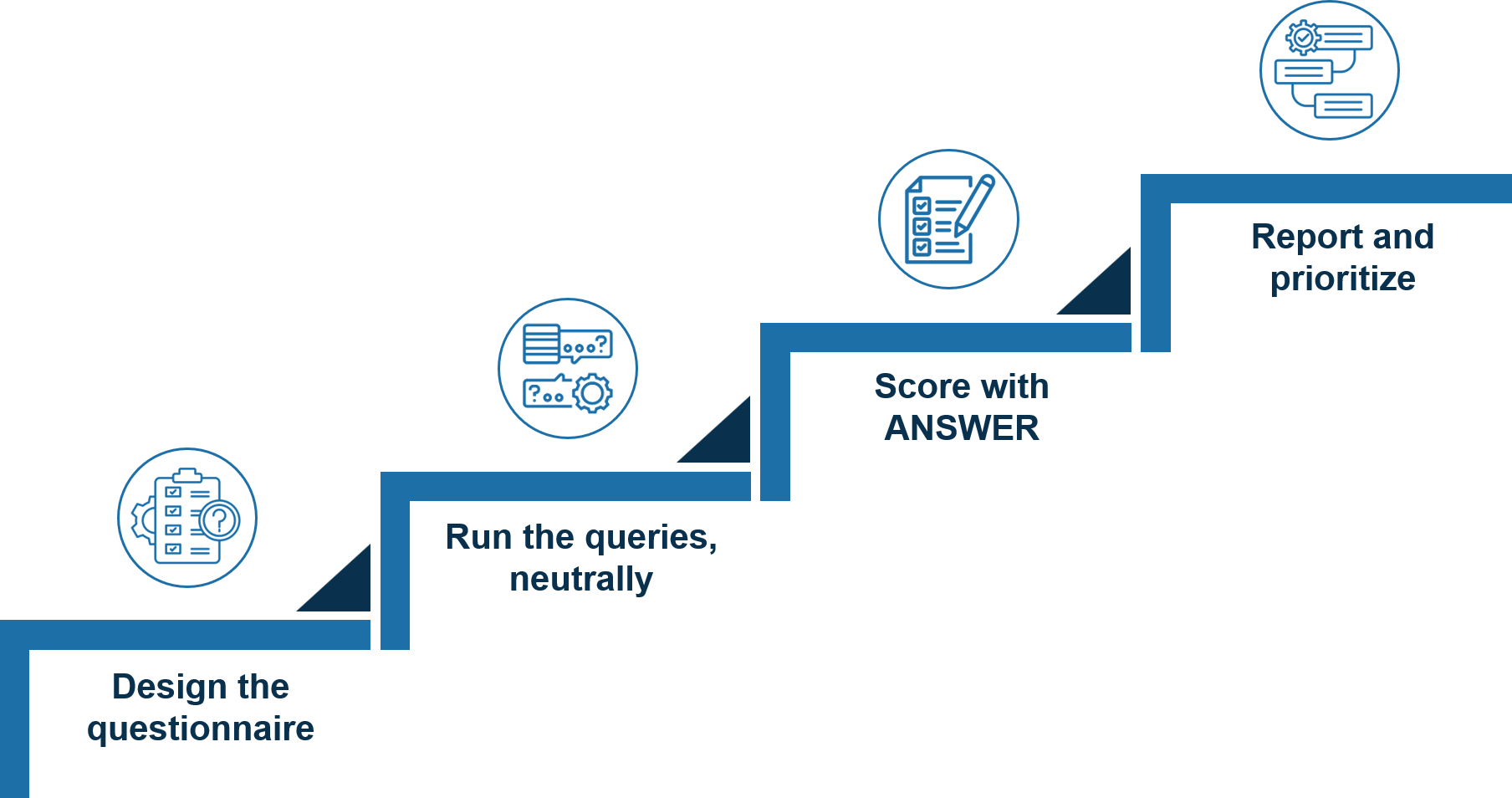
Phase 1: Question design. HiBot builds a tailored question set in your customer’s own language, across 6 categories that map to how customers actually decide. Questions are weighted toward whether you appear at all, and whether you win in direct comparisons, because those move outcomes the most.
Phase 2: Neutral collection. A human specialist asks every question by hand under 5 rules: logged out, fresh chat per question, in your target geography, across every engine in your tier, and captured verbatim.
Phase 3: Scoring. The captured text is scored with a framework called ANSWER, which produces a 0 to 100 HiBot Score and a plain-language band from Dominant to Invisible. Any answer with a factual error gets capped, so a brand can’t rack up points on questions where the AI is confidently wrong about it.
Phase 4: The report. You get a detailed writeup. Your score. The category-by-category and engine-by-engine breakdown. Every question with the actual answer the AI gave. And a ranked list of what to fix first.
The Two Plans
There are two tiers. The choice mostly comes down to how deep you need to look and how many engines matter for your buyer.
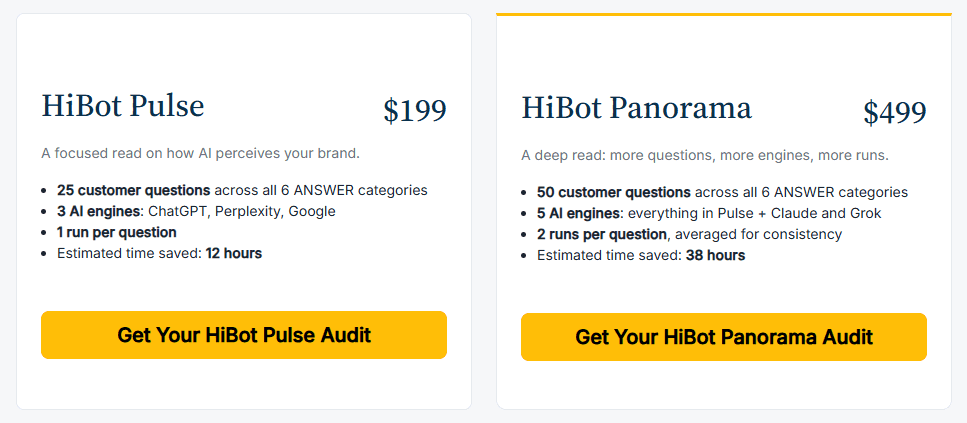
Pulse is the right starting point for most solo operators and small brands. It answers “am I invisible, am I being misrepresented, and who is AI picking instead of me” for under $200. If the audit surfaces something serious, or your buyer skews toward Claude or Grok, Panorama gives you the full picture.
Both plans are one-time purchases. No subscription. No seat license. No minimum term.
Real Reports on Brands You Know
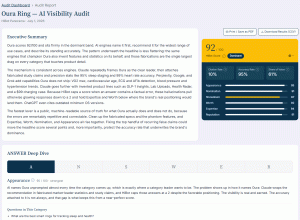 HiBot publishes full sample audits on real brands, which is the closest you’ll get to seeing exactly what you’re buying before you buy it. Two worth downloading:
Costco. Scored 93/100. A dominant brand with a perfect reputation score. It also has Google confidently stating false warranty and membership pricing claims as fact, and losing recommendations to Sam’s Club in categories Costco should own. Full report here.
Oura Ring. Scored 92/100. Another “dominant” brand on the headline number. The audit found 4 products the AI invented that don’t exist, plus features and stats fabricated and stated as fact. Full report here.
Both are the exact format you receive when you order your own. If you’re on the fence, read one before you buy.
FAQs
Isn’t this just SEO with a new coat of paint?
No. Traditional SEO ranks a page in a list. AI visibility work shapes what a single generated paragraph says about you. Different mechanic, different levers, different measurement. The overlap is that both start with the same question: what does the customer actually see?
Can I just run the audit myself with a scraping tool?
You can try. The honest answer is that scrapers get flagged, the sessions aren’t neutral, the geo is wrong, and you can’t easily capture the sourced citations. You’ll end up with data that looks like an audit but doesn’t hold up to a second look. The specialist-run process is the point.
How often should I re-run it?
Every model update can shift your score. Quarterly is a reasonable cadence for most brands. If you’re actively working on your AI visibility, monthly makes sense so you can tell whether the work is moving the number.
What do I actually do with the report?
The report ships with a prioritized action list. It usually points at two or three levers: fixing content the AI is misreading, correcting a claim that shows up in multiple engines’ training data, and shoring up third-party sources the models cite. It’s not a black box, and the fixes are usually concrete.
How long does an audit take to deliver?
The site doesn’t publish a firm SLA. In practice, expect around a week for Pulse and roughly two weeks for Panorama, since Panorama is 10x the raw data collection.
Is this useful for a service business, or only for products?
Both. The audit works anywhere a customer would ask an AI “who should I hire for X” or “which platform is best for Y.” I’ve seen it used on SaaS, consulting firms, ecommerce, and local service businesses.
Do I need to be a big brand for this to be worth it?
The opposite. Big brands already have a team watching this. Small operators are the ones getting quietly skipped or misrepresented, and they’re the ones who can move the needle fastest once they see the report.
The Take
If you’re selling into a market where customers use AI to compare options, and that’s basically every market at this point, you need a baseline of what those engines are telling them. Guessing doesn’t work. Checking your own logged-in ChatGPT is worse than guessing, because it flatters you.
Two hundred bucks for a real read on where you stand is a rounding error against what it costs to keep marketing into a customer conversation you can’t see. Whether you go with HiBot or somebody else, do the audit. Then decide.